

AI-Mediated Inbox Environments: Implications for Email Marketing Strategy and Deliverability (Guest Post)
 Follow
(Guest Post from the PMA AI Council, authored by Denis Babaev)
Executive Summary
After Google I/O on May 19, 2026, the internet exploded with hot takes about the end of SEO. Google made the biggest change to its search business in 25 years. But while the marketing world was laser-focused on search, something arguably more consequential slipped under the radar: Gmail’s AI Inbox.
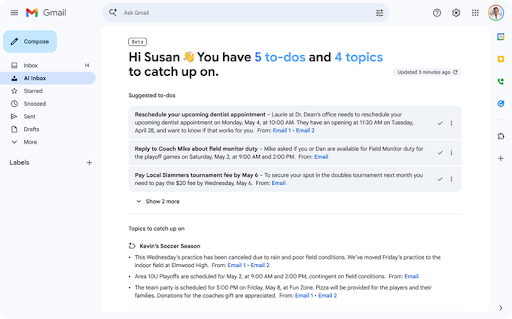
The Gemini-powered AI Inbox — which surfaces prioritized to-dos and message highlights rather than a chronological message list — is now rolling out broadly to AI Plus and Pro subscribers in the United States.
This points to a structural shift: an AI intermediary now sits between commercial senders and their subscribers, deciding what gets surfaced, how it is summarized, and whether it registers as worth the reader’s attention. Google is not alone. Apple Intelligence, in broad deployment since late 2024, has been silently replacing sender-authored preview text with on-device AI summaries across Apple Mail — currently the world’s largest email client by open share at 51.52% (Q1 2025). Yahoo is following a parallel trajectory.
This does not signal the decline of email as a marketing channel. The underlying data — user base growth, consistent engagement benchmarks, and measurable return on investment — points in the opposite direction, as documented in Section 1. What it signals is that the *operating conditions* for commercial email programs are changing in ways that require deliberate technical and strategic adaptation.
This article examines the structural changes introduced by AI-mediated inbox environments, their compliance and deliverability implications, and the tactical adjustments email programs should implement to maintain engagement and sender authority in this new operating context.
—
1. The Structural Importance of Email as a Marketing Channel
Before addressing the disruptions, practitioners should contextualize the channel’s current standing relative to competing digital media.
Email’s universal penetration and platform independence distinguish it from every social channel. Facebook skews toward older demographics in Western markets; TikTok toward Gen Z; LinkedIn is exclusively professional. WeChat commands near-total market share in China but minimal presence elsewhere. Each platform represents a walled garden — controlled by a single entity that owns the algorithm, the audience relationship, and the ability to revoke access.
Email, by contrast, operates on open standards (SMTP, IMAP, MIME). Subscriber lists are portable assets that do not vest in a platform provider. A marketer who loses access to a social platform loses their audience. A marketer with a compliant, permission-based email list retains it.
This structural portability is the foundational argument made by email-first publishers, and it remains valid — with an important caveat that the open-protocol architecture has historically attracted high spam volumes, necessitating increasingly sophisticated inbox filtering.
Key channel metrics (2025–2026):
| Metric | Value | Source |
| Global email users (2026 projected) | 4.73 billion | Statista |
| Daily emails sent (2025) | 376.4 billion | Statista |
| Average email marketing ROI | $36–$43 per $1 spent | Litmus / Sender |
| Average open rate (2025, all industries) | 42.35% | Designmodo / Genesys Growth |
| Average CTR (all campaigns) | ~2.0% | Omnisend |
| Welcome email average open rate | ~50% | Industry consensus |
| Automated email share of revenue | 30% (from 2% of sends) | Omnisend 2026 |
**Note on open rate reliability:** Apple’s Mail Privacy Protection (MPP), which pre-loads tracking pixels for Apple Mail users, inflates reported open rates by an estimated 4–8 percentage points (DigitalApplied, 2026). Programs should treat open rate as a directional indicator and prioritize click-through rate, revenue-per-send, and reply rate as primary engagement KPIs.
2. The AI Inbox Transition: Platform-by-Platform Analysis
| Gmail AI Inbox: | Apple Intelligence in Mail: | Yahoo Mail AI-Powered Inbox: |
 |  |  |
| Source: https://x.com/gmail/status/2039107985281008078 | Source: https://support.apple.com/guide/iphone/use-apple-intelligence-in-mail-iph9ae667055/ios | Source: https://www.yahooinc.com/press/yahoo-mail-launches-a-new-app-experience-with-mobile-first-ai-features |
2.1 Gmail (Google)
Gmail holds approximately 29–31% of email client market share by active account volume and processes over 1.8 billion active users globally. The platform’s decisions have downstream effects on a significant portion of commercial email traffic.
At Google I/O (May 19, 2026), Google confirmed two developments with material implications for email marketers:
Gmail AI Inbox: A Gemini-powered inbox view that surfaces prioritized to-do items and message highlights rather than presenting email in standard chronological order. This view sits above the traditional inbox interface. Messages that are not flagged as high-priority by the Gemini model risk functional invisibility — technically delivered, but not surfaced without deliberate navigation by the subscriber. The rollout initially targeted Google AI Ultra subscribers and is expanding to AI Plus and Pro tiers in the United States.
Gmail Live: A conversational AI interface through which users can ask natural-language questions about inbox contents, extract specific items (discount codes, event details, action items), and receive summarized responses — without opening individual messages. The deliverability implication: subscribers may act on content extracted from a message without registering a traditional “open” event.
Both features compound an existing concern raised by Nicholas Thompson (CEO, The Atlantic) at The Newsletter Conference (New York, May 15, 2026): that a dedicated “Newsletters” tab in Gmail — analogous to the existing Promotions tab — would effectively quarantine newsletter content from primary inbox visibility. Historical data on the Promotions tab demonstrates that most subscribers do not actively navigate to it; click-through and conversion rates for Promotions-tab emails are significantly depressed versus Primary inbox placement.
2.2 Apple Mail
Apple Mail holds the largest email client market share by open share — approximately 51.52% as of Q1 2025 — making it the single most consequential rendering environment for commercial email programs.
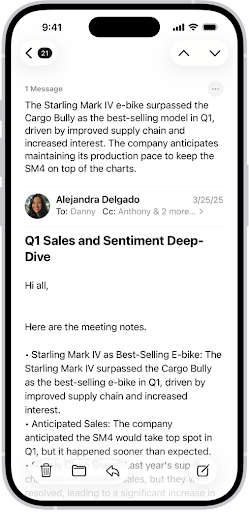
Apple Intelligence, deployed broadly in late 2024, replaces sender-authored preview text (preheader copy) with AI-generated summaries produced on-device via Apple’s on-device language models. These summaries are enabled by default and cannot be suppressed by the sender. For programs that have invested in crafted preheader copy as a conversion lever — a practice long recommended as best practice — the practical implication is that the majority of email opens now occur in an environment where the sender’s preheader has been overwritten.
2.3 Yahoo Mail
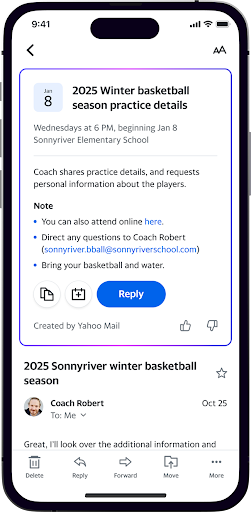
Yahoo Mail accounts for approximately 225 million active users and 2–3% of client market share. The platform has been incrementally deploying AI-powered inbox management features, following a pattern consistent with Google and Apple. Practitioners should treat Yahoo’s trajectory as broadly aligned with the market direction established by the two dominant players.
3. Compliance and Technical Considerations
3.1 CAN-SPAM and Commercial Email Obligations
The PMA Compliance Council’s guidance on email marketing remains foundational for any program operating in AI-mediated inbox environments. The CAN-SPAM Act applies to all commercial electronic mail messages regardless of volume, business-to-consumer or business-to-business context, or delivery channel. Each non-compliant email is subject to civil penalties of up to $16,000 per message.
AI inbox features do not create new legal obligations, but they do increase scrutiny on sender behavior. Programs that rely on misleading subject lines, deceptive from-name attribution, or failure to honor opt-out requests will find that AI filtering models — trained on user engagement and complaint data — compound the deliverability consequences that legal non-compliance already creates.
3.2 Authentication Infrastructure
Google and Yahoo’s 2024 DMARC requirements represent a baseline, not a ceiling. Programs should ensure:
- Full SPF record alignment for all sending domains
- DKIM signing on all outbound commercial messages
- DMARC policy at minimum p=quarantine with regular aggregate report review
- BIMI (Brand Indicators for Message Identification) implementation, now associated with measurable inbox visibility improvements as inbox providers surface verified sender logos
3.3 Data and List Quality
AI inbox models rely heavily on subscriber engagement signals — opens, clicks, replies, forwards, and explicit “mark as important” actions — to determine inbox placement. Programs with degraded list hygiene (inactive subscribers, unconfirmed opt-ins, high complaint rates) will produce engagement signal distributions that depress deliverability across the entire sending domain.
Double opt-in confirmation remains the highest-signal list acquisition method available. A subscriber who actively confirms their signup produces an engagement signal at the point of acquisition that is demonstrably distinct from single opt-in or co-registration sources.
4. Strategic and Tactical Recommendations
The following recommendations are organized by implementation complexity and expected impact.
4.1 Optimize the Welcome Sequence as an AI Relationship Signal
Welcome emails currently produce average open rates of approximately 50% — substantially above the 42.35% industry-wide average — because subscribers are at peak attention and intent at the point of acquisition. In AI-mediated inbox environments, the welcome email carries an additional function: it is the first opportunity to establish the engagement signals that inbox AI models use to classify sender importance.
Recommended practices:
- Implement double opt-in. Confirmed subscribers produce stronger initial engagement signals. The marginal list size reduction is offset by improved deliverability and engagement rates.
- Request a reply. A reply from the subscriber creates a bidirectional engagement signal that is highly weighted by inbox classification models. In practical terms, a reply typically moves a sender from Promotions to Primary inbox placement in Gmail. Welcome emails should include a specific, low-friction prompt that encourages a reply (e.g., “Reply and tell me the one thing you most want to learn about X”).
- Request contact addition. Subscribers who add the sender address to their contacts trigger an explicit trust signal that overrides algorithmic inbox classification. Include a direct, visual instruction for this action in the welcome message.
4.2 Implement Hidden-Div AI Summaries
With Apple Intelligence replacing sender preheader text for approximately 51% of email opens, practitioners should implement a structured “hidden div” summary — a plain-text content block placed immediately after the preheader, hidden from visible rendering but accessible to email client AI parsers.
Current evidence indicates that Apple Intelligence, Gmail’s Gemini summarization, and related models preferentially extract high-density, plain-language content near the top of the email body. By providing a purpose-authored summary in this position, senders can increase the probability that AI-generated previews reflect intended messaging rather than arbitrary content extraction.
Technical specification:
html
<div style=”display:none !important; visibility:hidden; mso-hide:all;
font-size:1px; color:#ffffff; line-height:1px; max-height:0px;
max-width:0px; opacity:0; overflow:hidden;”>
[Plain-language summary: 150–200 characters. Factual. No marketing language.
Example: “This week: three deliverability changes from Google I/O and
what they mean for your open rates.”]
</div>
This pattern is the functional equivalent of a meta description for search engine indexing — a structured signal provided to the parsing layer to improve how content is represented in downstream surfaces.
4.3 Realign Subject Line Strategy for AI Evaluation
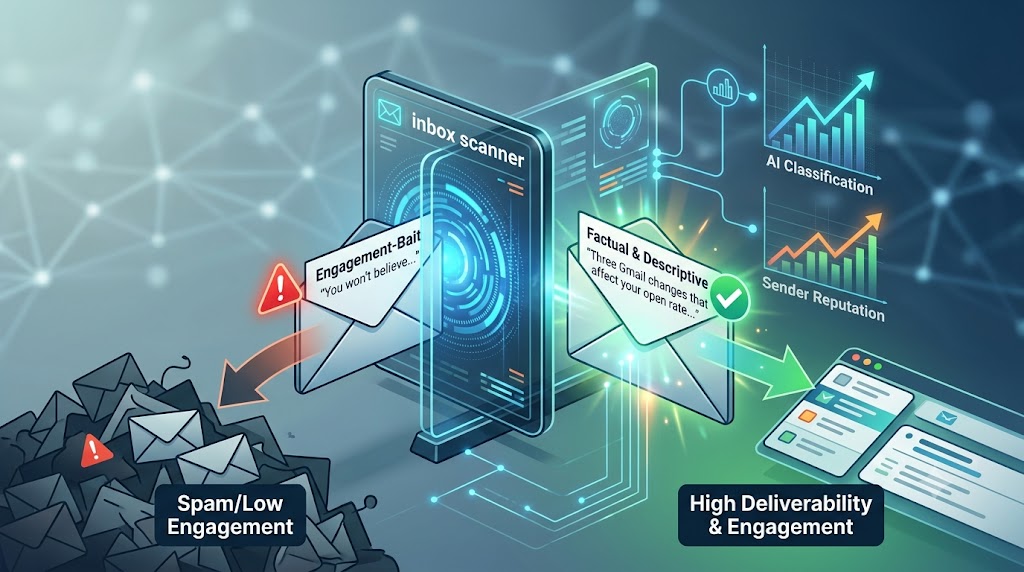
Engagement-bait subject lines (“You won’t believe what happened next…”) are increasingly penalized by two mechanisms simultaneously: (1) AI inbox models that evaluate subject-line-to-content alignment and (2) subscriber fatigue that drives complaint rates upward over time.
AI inbox models use subject lines as a primary classification input. A subject line that overpromises relative to email content creates a signal mismatch that degrades sender reputation with the inbox AI over time — an effect that compounds across the subscriber relationship.
Recommended approach: Subject lines should be specific, factual, and accurately descriptive of email content. Specificity outperforms ambiguity. “Three Gmail changes that affect your open rate” outperforms “Big news about your inbox” on both AI classification and click-through benchmarks.
Personalized subject lines remain effective: research by Adobe for Business indicates a 20–26% open rate lift from personalized subject lines. However, personalization should be semantically meaningful (behavioral or preference-based), not cosmetic (name insertion into generic templates).
4.4 Implement Schema.org Structured Data
Gmail’s interface already uses JSON-LD structured data to surface action buttons, promotional highlights, and event details in the inbox view — independently of whether the subscriber opens the message. Structured data markup gives inbox AI models a machine-readable content map, increasing the probability that email content is accurately extracted and presented in AI-summarized views, including Gmail Live.
Recommended implementation for newsletter/content emails:
html
<head>
<script type=”application/ld+json”>
{
“@context”: “http://schema.org”,
“@type”: “Message”,
“description”: “[Accurate 1–2 sentence description of email content]”,
“potentialAction”: {
“@type”: “ViewAction”,
“target”: “[Primary CTA URL]”,
“name”: “[Action label, e.g., ‘Read Full Analysis’]”
},
“publisher”: {
“@type”: “Organization”,
“name”: “[Brand Name]”,
“logo”: “[Logo URL]”
}
}
</script>
</head>
Transactional programs sending receipts, shipping notifications, and event confirmations should implement the corresponding transactional schema types, which are already processed by Gmail for native inbox UI rendering.
4.5 Prioritize Engagement Signal Accumulation Over List Scale
In AI-mediated inbox environments, sender authority is determined not by list size but by the aggregate engagement quality of the subscriber relationship. A list of 10,000 highly engaged subscribers who regularly open, click, and reply will produce substantially better inbox placement and AI classification outcomes than a list of 100,000 infrequently engaging subscribers.
Programs should implement regular re-engagement and sunset workflows to remove or segment subscribers who have not engaged within defined windows (typically 90–180 days depending on send frequency). The deliverability cost of maintaining unengaged subscribers on active send lists exceeds the marginal revenue benefit of maintaining apparent list scale.
Conclusion and Forward Outlook
Email is not a declining channel. The data indicates the opposite: user base growth, stable-to-improving open rates, and consistently unmatched ROI relative to competing digital channels. What is changing is the interface layer through which subscribers access email content, and the algorithmic intermediary — AI — that now participates in inbox curation, content summarization, and engagement signal evaluation.
For performance marketers, the operational implication is clear: sender authority in AI-mediated inbox environments is built through demonstrated subscriber relationships, not through volume or creative optimization alone. The practices that have always defined compliant, high-quality email programs — permission-based acquisition, authentic content, consistent engagement, and technical authentication — are now the precise inputs that AI inbox models use to determine whose messages get seen.
Programs that adapt their technical infrastructure (authentication, structured data, hidden-div summaries), their acquisition practices (double opt-in, high-engagement welcome sequences), and their content strategy (subject line specificity, brand voice consistency) are structurally well-positioned for the inbox environment of 2026 and beyond.
Programs that do not adapt will find that AI filtering compounds the existing consequences of poor list hygiene, non-compliant practices, and low-quality content — at a speed and scale that traditional filtering never achieved.
References and Data Sources
- Litmus (2026). Email Marketing ROI Benchmarks.
- Sender.net (2026). Email Marketing Statistics: Key Data Points.
- Statista (2025). Number of Email Users Worldwide, 2020–2027.
- Omnisend (2026). Ecommerce Email Marketing Statistics Report.
- DigitalApplied (2026). 200+ Email Marketing Statistics 2026.
- Designmodo (2026). 60+ Email Marketing ROI Statistics.
- Genesys Growth (2026). Email Open Rates: 50 Statistics for Marketing Leaders.
- Google (May 19, 2026). Google I/O 2026: All Announcements. blog.google
- Performance Marketing Association (2014). Guide to Email Marketing: Compliance Requirements and Best Practices. thePMA.org
- Performance Marketing Association (2025). Performance Marketing Industry Study 2025. thePMA.org
- Thompson, N. (May 15, 2026). Panel remarks at The Newsletter Conference, New York City.
- AI Inbox: Beta for Google AI Ultra subscribers in the US https://x.com/gmail/status/2039107985281008078
- Denis B. (May 2026). AI and the Inbox: The Future of Email Marketing: https://newsletter.scaleyourweb.com/p/ai-and-the-inbox-the-future-of-email-marketing
- Google I/O (May 19-20, 2026). https://blog.google/innovation-and-ai/technology/ai/google-io-2026-all-our-announcements/



Denis Babaiev